
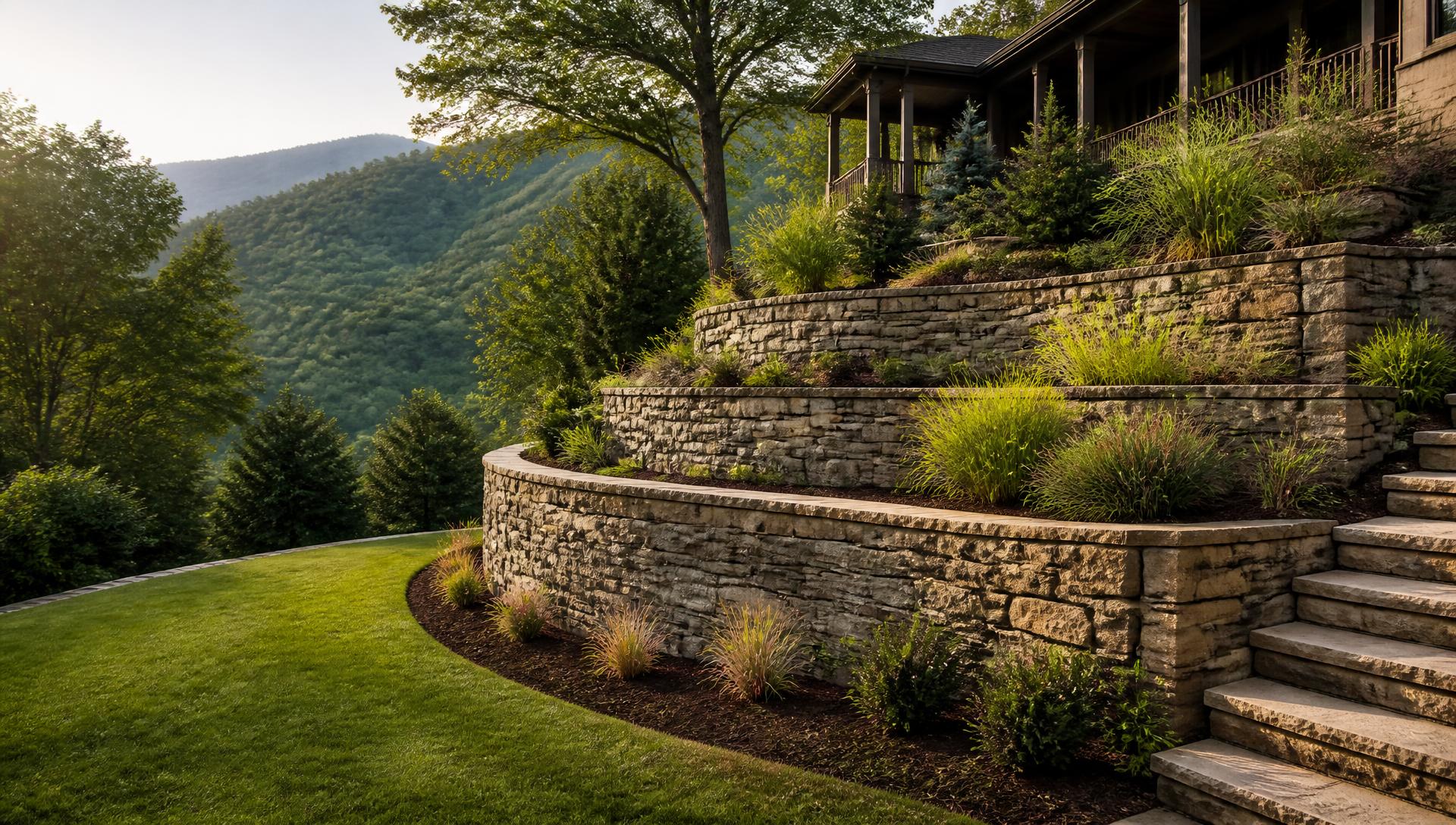
Structures
Engineered Segmental Block Retaining Walls in North Georgia
Reinforced segmental block walls with geogrid and drainage stone for tall grade changes on North Georgia hillsides.
When a wall gets tall, holds a driveway, or sits below a structure, it stops being landscaping and becomes engineering. Segmental block with geogrid reinforcement is a proven system — as long as base, grid, drainage and compaction are all built to the design.
Part of our Retaining Walls & Slope Grading in North Georgia work across North Georgia.
What we see most often
- Tall walls built with no geogrid and bulging within a few seasons
- Base course set too shallow or on uncompacted material
- Drainage aggregate omitted to save cost
- Walls supporting a drive or structure built without engineering
Scope of work
What this work includes
Engineering coordination
Working with a licensed engineer where height, surcharge or local code requires a stamped design, then building to it.
Base & leveling course
Excavation to competent soil, compacted aggregate leveling pad and correct embedment below finished grade.
Geogrid reinforcement
Reinforcement layers placed at design intervals and lengths, with backfill compacted in lifts over each layer.
Drainage & caps
Drainage aggregate, filter fabric, perforated pipe to daylight, then cap units and finished grading above and below.
A reinforced, drained, code-compliant wall that holds a driveway or structure without moving.
How it goes
Our process
- Step 01
Design
Determine height, surcharge and whether stamped plans are required.
- Step 02
Excavate
Dig to competent soil, allow for grid length behind the wall.
- Step 03
Build in lifts
Course, drainage, grid, compact — repeat to height.
- Step 04
Cap & grade
Cap units, outlet the drain, finish grade both sides.
Common questions
Block Walls questions we get
- When does a retaining wall need to be engineered?
- Commonly at around four feet of exposed height, and lower when there is a surcharge such as a driveway, pool or structure above it. Local code governs, and we confirm the threshold for your county before pricing.
- What is geogrid and do I need it?
- Geogrid is a reinforcement mesh laid into the backfill at intervals, tying the soil mass to the wall face. Above modest heights, a segmental wall without grid is relying on the blocks alone and will eventually deform.
- How long do block retaining walls last?
- Decades when base, grid, drainage and compaction are done to spec. The failures we get called to repair are almost always missing drainage or missing reinforcement.
- Can a block wall be curved or terraced?
- Yes. Curves are straightforward, and terracing can reduce the engineering demand — though terraces close together behave as one tall wall and still need design.
Where we work
Retaining Walls across North Georgia
We handle retaining walls for property owners across the north side of Atlanta — Cumming, Milton, Alpharetta, Roswell, Buckhead, Sandy Springs, Marietta, Woodstock, Canton and Ball Ground — and up through Jasper, Ellijay and Blue Ridge. Choose your area for local conditions, permitting and recent work nearby.
- Retaining Walls in AlpharettaFulton County
- Retaining Walls in RoswellFulton County
- Retaining Walls in Johns CreekFulton County
- Retaining Walls in BuckheadFulton County
- Retaining Walls in Sandy SpringsFulton County
- Retaining Walls in MariettaCobb County
- Retaining Walls in East CobbCobb County
- Retaining Walls in WoodstockCherokee County
- Retaining Walls in JasperPickens County
- Retaining Walls in EllijayGilmer County
- Retaining Walls in Blue RidgeFannin County
- Retaining Walls in DahlonegaLumpkin County
- Retaining Walls in HelenWhite County
- Retaining Walls in GainesvilleHall County
Regional overviews: Retaining Walls in Atlanta Metro, Retaining Walls in Lake Lanier, Retaining Walls in North Georgia Mountains, Retaining Walls in North Atlanta.
Also serving Cumming, Milton, Canton, Ball Ground, Dawsonville, Cartersville, Blairsville, Cleveland.
Related work
Start here
Tell us about your property
Send the basics and we'll come back with a straight answer on what your site needs, what order to do it in, and what it's likely to cost.