
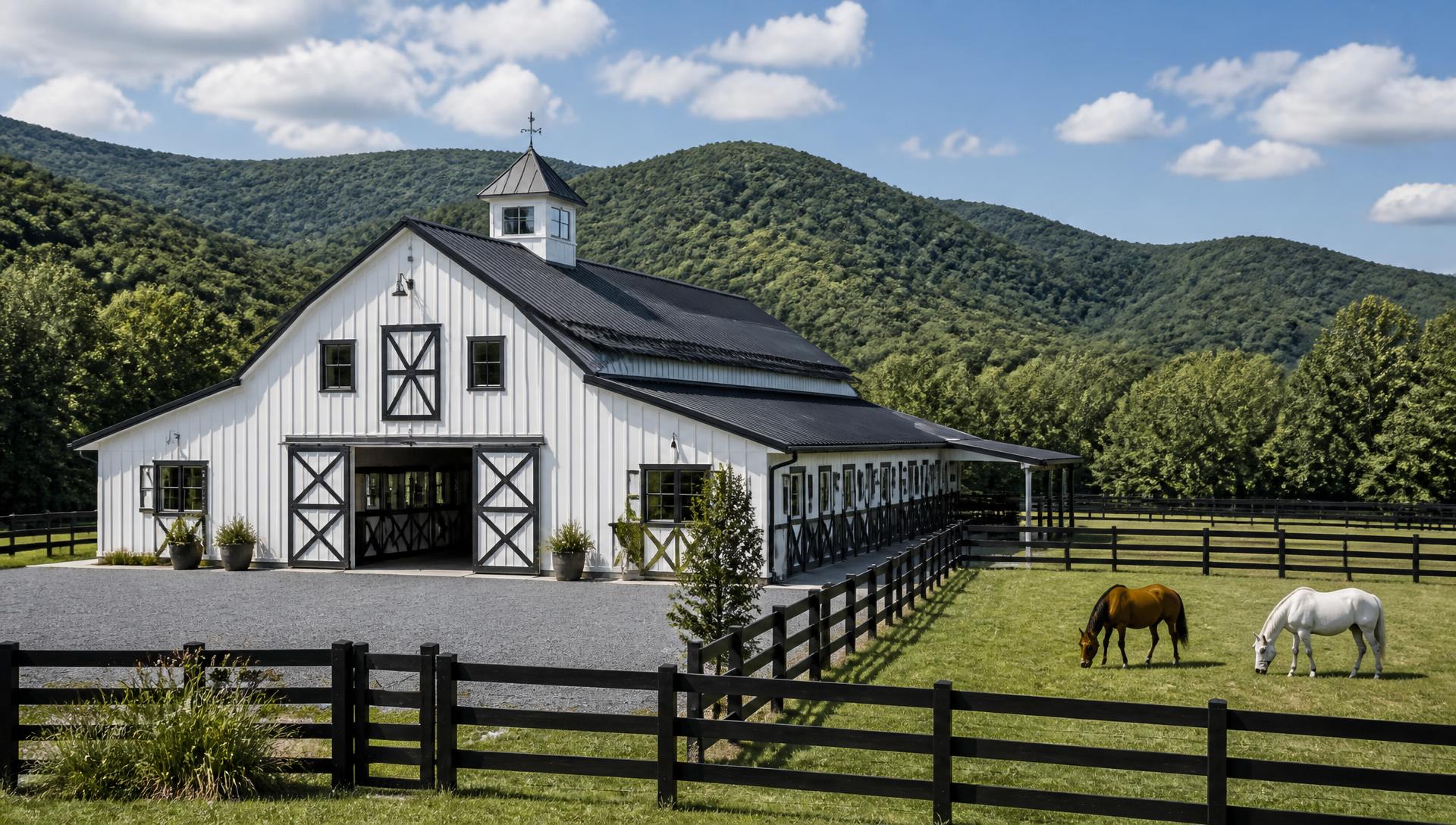
Equestrian
Riding Arena Construction & Grading in North Georgia
Laser-graded riding arenas with engineered base, drainage and footing for dressage, jumping and all-weather riding.
Riders talk about footing; arenas fail on base and water. The layers under the surface, the slope of the subgrade, and the perimeter drainage decide how many days a year you can ride. Footing sitting on a poorly built base never performs.
Part of our Equestrian Property Development in North Georgia work across North Georgia.
What we see most often
- Arenas holding water for days after a normal rain
- Footing mixing into the base because there is no separation layer
- Sited in a low area that collects runoff from the whole property
- Surface too deep or too shallow for the discipline being ridden
Scope of work
What this work includes
Site selection & diversion
Choosing ground that drains and intercepting every bit of upslope runoff before it reaches the arena.
Subgrade & base
Graded, compacted subgrade with the correct slope, then a stone base built in lifts to hold under hooves and drags.
Separation & drainage
Geotextile between base and footing, perimeter drains and outfalls that carry water clear of the pad.
Footing installation
Sand, blends or additive footing placed to a consistent depth matched to the discipline you ride.
An arena you can ride the afternoon after a storm, with footing that stays consistent.
How it goes
Our process
- Step 01
Locate
Find ground that drains and can be reached with a truck.
- Step 02
Divert
Cut off upslope water before touching the arena footprint.
- Step 03
Build the base
Subgrade slope, stone lifts, compaction, fabric.
- Step 04
Footing
Place, level and set depth, then confirm with a ride.
Common questions
Riding Arenas questions we get
- What size should a riding arena be?
- Roughly 60 by 120 feet is a common all-purpose outdoor size; dressage courts are 20 by 40 or 20 by 60 meters, and jumping needs more room. Choose the discipline first, since the pad is expensive to enlarge later.
- How much slope does an arena need?
- Typically a slight consistent grade — often under one percent — across the base so water moves without riders feeling it. Flat arenas hold water; steep ones ride badly.
- How long after rain can I ride?
- A properly based and drained arena is usually rideable within hours. If yours needs days, the problem is under the footing, not in it.
- Can you fix an existing arena instead of rebuilding?
- Often. Adding perimeter drainage, correcting slope and installing separation fabric solves many arenas without replacing the footing.
Where we work
Equestrian across North Georgia
We handle equestrian for property owners across the north side of Atlanta — Cumming, Milton, Alpharetta, Roswell, Buckhead, Sandy Springs, Marietta, Woodstock, Canton and Ball Ground — and up through Jasper, Ellijay and Blue Ridge. Choose your area for local conditions, permitting and recent work nearby.
- Equestrian in CummingForsyth County
- Equestrian in MiltonFulton County
- Equestrian in CantonCherokee County
- Equestrian in DawsonvilleDawson County
- Equestrian in BlairsvilleUnion County
- Equestrian in ClevelandWhite County
Regional overviews: Equestrian in North Georgia, Equestrian in North Georgia Ranch & Equestrian Properties.
Also serving Alpharetta, Roswell, Johns Creek, Buckhead, Sandy Springs, Marietta, East Cobb, Woodstock, Ball Ground, Jasper, Ellijay, Blue Ridge, Cartersville, Dahlonega, Helen, Gainesville.
Related work
Start here
Tell us about your property
Send the basics and we'll come back with a straight answer on what your site needs, what order to do it in, and what it's likely to cost.