
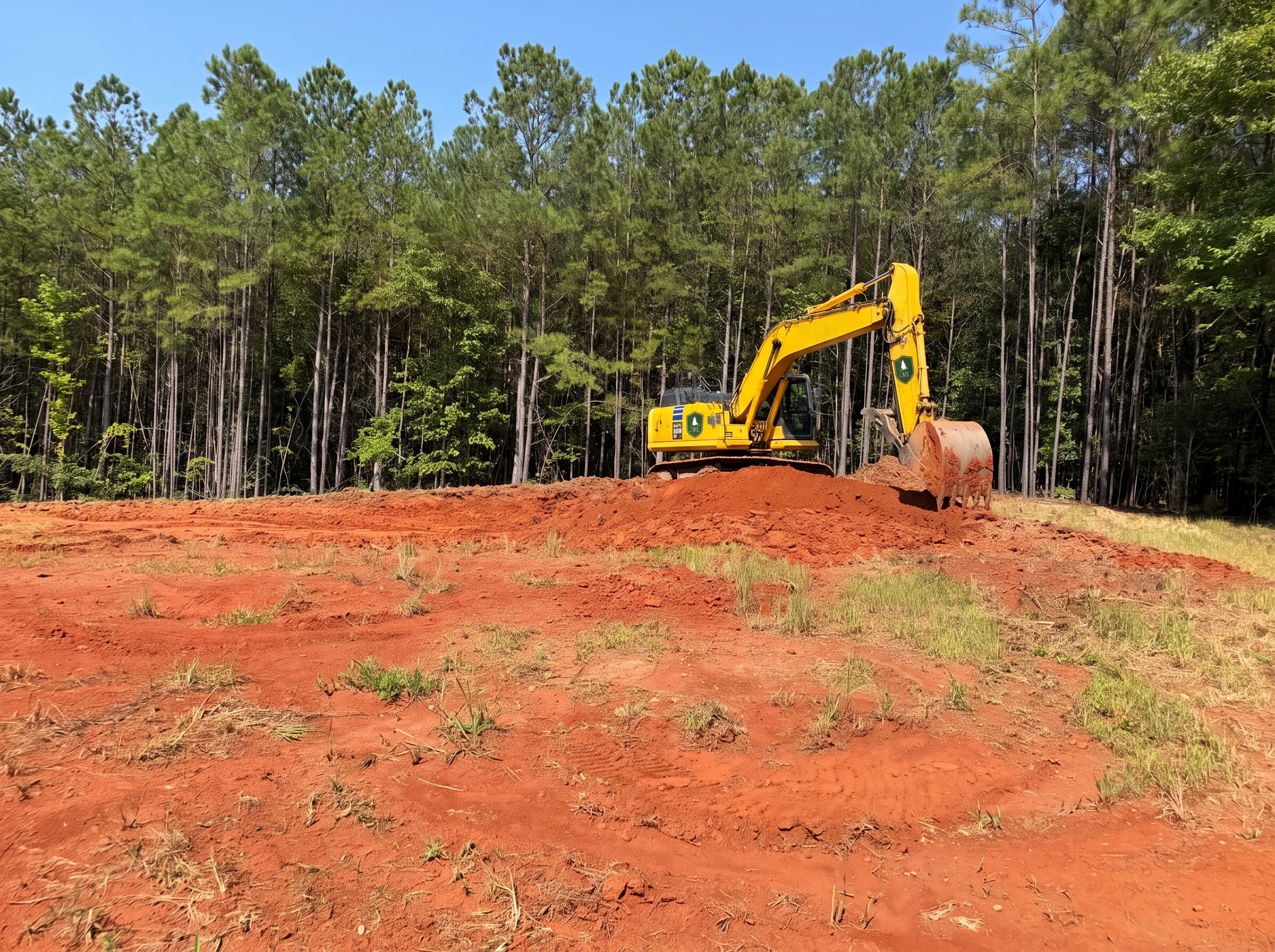
Site work
Pasture Grading, Topsoil & Seeding in North Georgia
Pasture renovation, grading, topsoil placement, liming and fescue seeding for horse and cattle farms across North Georgia.
Cleared ground is not pasture. Georgia red clay compacts hard, drains poorly and grows weeds before it grows forage. Restoring a field means fixing the surface, fixing the soil, and seeding at the right time of year for the mix you want.
Part of our Land Development & Site Work in North Georgia work across North Georgia.
What we see most often
- Rough, rocky ground that beats up a mower and holds water in ruts
- Soil never tested, so lime and fertilizer are guesses
- Seed broadcast at the wrong season and washed off before it germinated
- Old logging ruts and skid trails left to erode into gullies
Scope of work
What this work includes
Surface repair
Filling ruts and gullies, removing surface rock and stumps, and smoothing the field to a grade you can mow and hay.
Soil correction
Soil testing, lime and amendment application to bring pH into a range where forage will actually compete with weeds.
Seedbed & seeding
Disking or no-till drilling, then seeding a fescue, bermuda or mixed stand suited to the field's use and exposure.
Erosion control
Diversion of concentrated flow, matting on slopes and cover crop where a permanent stand needs time to establish.
A smooth, drained, correctly amended field that carries stock or cuts hay instead of growing weeds.
How it goes
Our process
- Step 01
Assess
Walk the field, pull soil samples, identify wet areas and flow paths.
- Step 02
Shape
Grade out ruts, gullies and low spots that hold water.
- Step 03
Amend
Apply lime and nutrients based on the test, not on habit.
- Step 04
Seed & protect
Seed in season, then mat and manage until the stand holds.
Common questions
Pasture Restoration questions we get
- When is the best time to seed pasture in North Georgia?
- Cool-season grasses such as tall fescue establish best in early fall, with late winter as a second window. Warm-season grasses like bermuda go in during late spring. Seeding outside those windows usually means reseeding.
- Do I really need a soil test?
- Yes. Most North Georgia pasture soils are acidic enough that forage cannot use the fertilizer you apply. Lime is inexpensive compared with reseeding a stand that failed because the pH was wrong.
- Can you fix a pasture without tearing it all up?
- Often. If the existing stand has decent coverage, no-till drilling into it plus lime and weed control is cheaper and faster than a full renovation.
- How soon can horses or cattle graze new pasture?
- Typically after the stand is well rooted and has been clipped once — often several months. Grazing too early pulls new plants out by the roots and undoes the work.
Where we work
Land Development across North Georgia
We handle land development for property owners across the north side of Atlanta — Cumming, Milton, Alpharetta, Roswell, Buckhead, Sandy Springs, Marietta, Woodstock, Canton and Ball Ground — and up through Jasper, Ellijay and Blue Ridge. Choose your area for local conditions, permitting and recent work nearby.
- Land Development in CummingForsyth County
- Land Development in MiltonFulton County
- Land Development in AlpharettaFulton County
- Land Development in RoswellFulton County
- Land Development in WoodstockCherokee County
- Land Development in CantonCherokee County
- Land Development in Ball GroundCherokee County
- Land Development in JasperPickens County
- Land Development in EllijayGilmer County
- Land Development in Blue RidgeFannin County
- Land Development in DawsonvilleDawson County
- Land Development in CartersvilleBartow County
- Land Development in DahlonegaLumpkin County
- Land Development in BlairsvilleUnion County
- Land Development in ClevelandWhite County
- Land Development in GainesvilleHall County
Regional overviews: Land Development in North Georgia, Land Development in Atlanta Metro, Land Development in North Georgia Mountains, Land Development in North Atlanta.
Also serving Johns Creek, Buckhead, Sandy Springs, Marietta, East Cobb, Helen.
Related work
Land Clearing
Selective land clearing, brush mulching, stump grinding and lot clearing for acreage in Cherokee, Forsyth, Dawson and Pickens County.
ViewSite Grading
Rough and finish grading, cut-and-fill balancing and compacted subgrade for homesites, barns and pastures on North Georgia acreage.
ViewBuilding Pads
Engineered, compacted building pads for homes, barns and shops — sited, drained and proof-rolled before the slab is poured.
ViewStart here
Tell us about your property
Send the basics and we'll come back with a straight answer on what your site needs, what order to do it in, and what it's likely to cost.