
Structures
Boulder & Natural Stone Retaining Walls in North Georgia
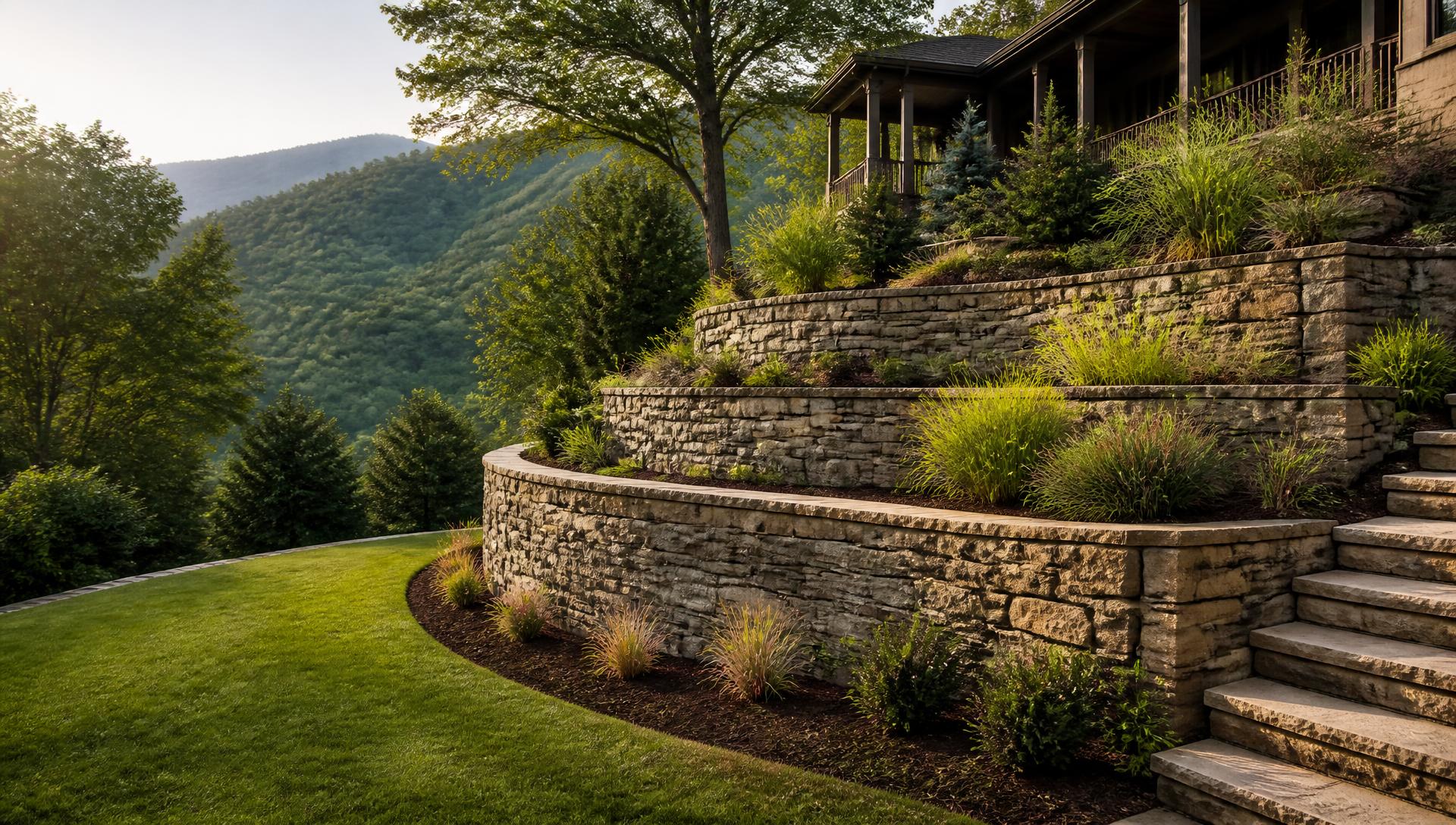
Native boulder and stacked stone retaining walls that hold grade, control erosion and look like they came off the property.
A boulder wall succeeds or fails behind the face. Base preparation, batter, and drainage decide whether it holds; stone selection and placement decide whether it looks like part of the hillside or a pile of rocks.
Part of our Retaining Walls & Slope Grading in North Georgia work across North Georgia.
What we see most often
- Walls leaning or bulging from hydrostatic pressure behind them
- Boulders set on soil instead of a compacted base
- No drainage stone or pipe, so water loads the wall in every storm
- Mismatched stone that reads as imported rather than native
Scope of work
What this work includes
Excavation & base
Digging to competent soil and building a compacted stone base with the embedment the wall height requires.
Stone selection & placement
Local granite and fieldstone chosen for size and face, then placed individually with batter into the slope.
Drainage system
Washed stone backfill, filter fabric and perforated drain pipe with an outlet so water never loads the wall.
Grading & planting
Finished grade above and below the wall, plus planting pockets that soften the face as it establishes.
A wall that holds the hill, drains itself, and looks like it was always there.
How it goes
Our process
- Step 01
Assess the slope
Height, soil, surcharge and water above the wall.
- Step 02
Excavate & base
Dig to competent soil, build and compact the base course.
- Step 03
Set stone
Place each boulder with batter, bearing and a tight face.
- Step 04
Drain & backfill
Stone, fabric, drain pipe and outlet before finish grading.
Common questions
Boulder Walls questions we get
- How tall can a boulder wall be?
- Modest walls are routine, but height thresholds — often around four feet — trigger engineering and permitting in many jurisdictions, and surcharge from a driveway or structure above lowers that threshold. We tell you when an engineer is required.
- Why do retaining walls fail?
- Water, nearly every time. Saturated soil behind a wall exerts enormous pressure. Drainage stone, fabric and a working outlet matter more than the size of the stone in the face.
- Boulder wall or block wall?
- Boulders look natural and suit rural and wooded settings; segmental block gives crisp geometry and engineered performance at height. Cost is often comparable, so the choice is usually aesthetic and structural context.
- Do boulder walls need maintenance?
- Very little when built properly. Keep the drain outlet clear and manage what grows in the face; the wall itself should not move.
Where we work
Retaining Walls across North Georgia
We handle retaining walls for property owners across the north side of Atlanta — Cumming, Milton, Alpharetta, Roswell, Buckhead, Sandy Springs, Marietta, Woodstock, Canton and Ball Ground — and up through Jasper, Ellijay and Blue Ridge. Choose your area for local conditions, permitting and recent work nearby.
- Retaining Walls in AlpharettaFulton County
- Retaining Walls in RoswellFulton County
- Retaining Walls in Johns CreekFulton County
- Retaining Walls in BuckheadFulton County
- Retaining Walls in Sandy SpringsFulton County
- Retaining Walls in MariettaCobb County
- Retaining Walls in East CobbCobb County
- Retaining Walls in WoodstockCherokee County
- Retaining Walls in JasperPickens County
- Retaining Walls in EllijayGilmer County
- Retaining Walls in Blue RidgeFannin County
- Retaining Walls in DahlonegaLumpkin County
- Retaining Walls in HelenWhite County
- Retaining Walls in GainesvilleHall County
Regional overviews: Retaining Walls in Atlanta Metro, Retaining Walls in Lake Lanier, Retaining Walls in North Georgia Mountains, Retaining Walls in North Atlanta.
Also serving Cumming, Milton, Canton, Ball Ground, Dawsonville, Cartersville, Blairsville, Cleveland.
Related work
Start here
Tell us about your property
Send the basics and we'll come back with a straight answer on what your site needs, what order to do it in, and what it's likely to cost.