
Water first
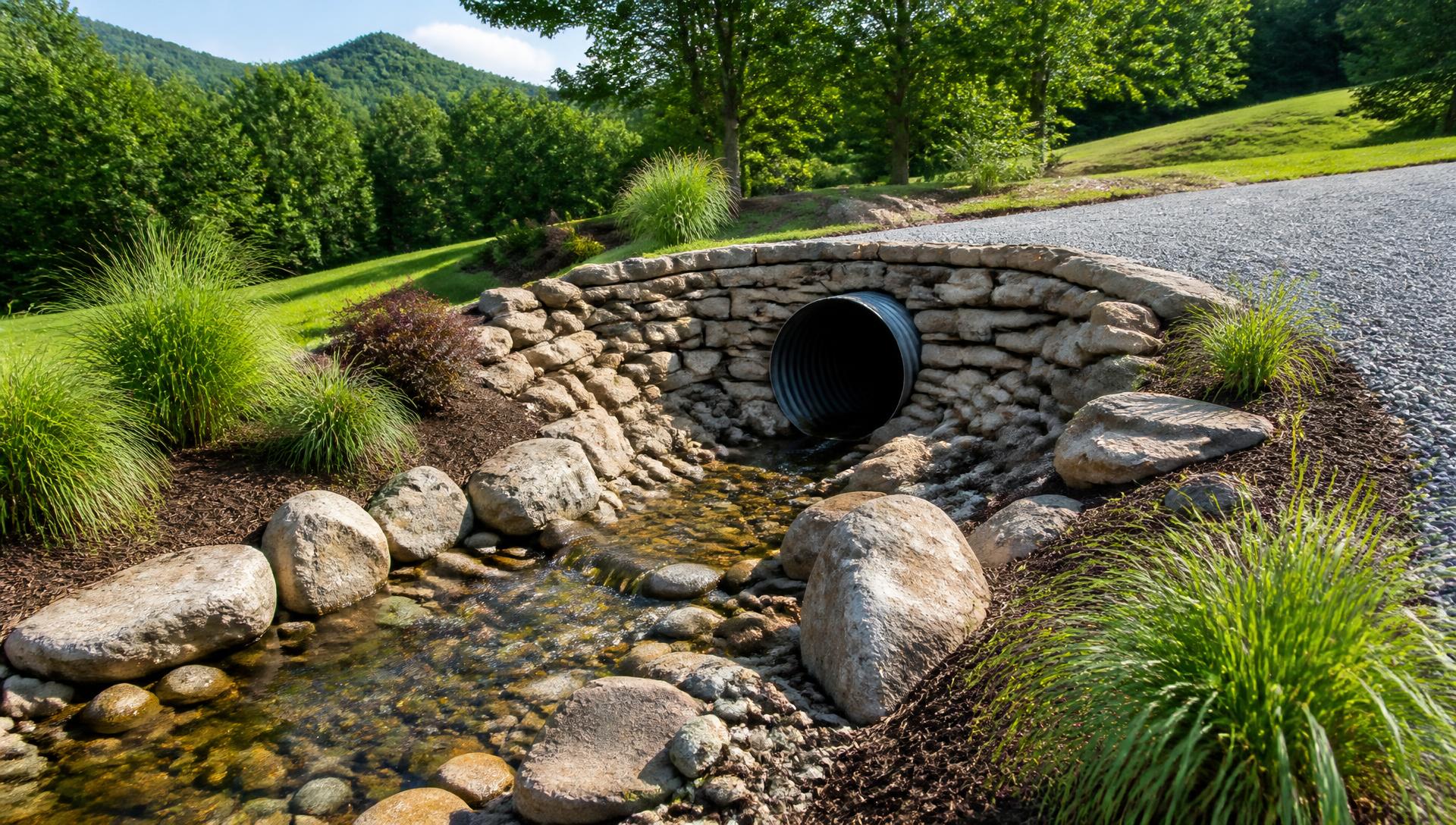
Culvert & Catch Basin Installation in North Georgia
Properly sized culverts, catch basins, cross-drains and outfalls that move storm volume off driveways, fields and building sites.
Undersized pipe is the most common drainage mistake on rural property. A culvert has to pass the flow its watershed delivers in a hard storm, sit at the right invert, and be protected at both ends. Get any of those wrong and the pipe becomes a dam.
Part of our Drainage & Erosion Control in North Georgia work across North Georgia.
What we see most often
- Culverts crushed, silted shut or set above the ditch line
- Water backing up and running over the driveway during storms
- Pipe outlets scouring a hole and undercutting the drive
- No cross-drains, so the whole drive becomes the channel
Scope of work
What this work includes
Sizing & invert design
Contributing area, slope and storm intensity used to size pipe and set inlet and outlet elevations correctly.
Culvert installation & replacement
HDPE, corrugated metal or concrete pipe bedded in stone with proper cover for the traffic crossing it.
Headwalls & end protection
Stone, concrete or flared end sections plus riprap aprons that stop scour and keep banks from collapsing.
Catch basins & cross-drains
Grated inlets, junction boxes and rolling cross-drains that pull water off long driveway runs before it gains speed.
Crossings that pass a hard storm without overtopping, scouring or washing out the drive.
How it goes
Our process
- Step 01
Measure the watershed
Establish how much water the crossing actually receives.
- Step 02
Set inverts
Fix inlet and outlet elevations before ordering pipe.
- Step 03
Install & bed
Trench, bed, backfill and compact for the load above.
- Step 04
Protect the ends
Headwalls, aprons and riprap sized to the outlet velocity.
Common questions
Culverts & Basins questions we get
- What size culvert do I need for my driveway?
- It is set by the drainage area feeding the crossing, its slope, and local storm intensity. Fifteen inches is a common minimum for a residential drive, but many rural crossings need eighteen to thirty-six inches or larger. Undersizing is the failure we replace most often.
- How much cover does a culvert need?
- Generally at least twelve inches of compacted cover over the pipe for a residential drive, more for heavier equipment. Too little cover and the pipe deforms under loaded trucks.
- Do I need a permit for a culvert?
- For a driveway tying into a county road, usually yes, and the county often dictates pipe size and material. Crossings on a stream trigger additional review. We handle the coordination.
- Can an existing culvert be cleaned instead of replaced?
- If the pipe is intact and only silted, flushing or jetting works. If it is crushed, separated, rusted through or badly undersized, replacement is cheaper than repeating the repair.
Where we work
Drainage & Erosion across North Georgia
We handle drainage & erosion for property owners across the north side of Atlanta — Cumming, Milton, Alpharetta, Roswell, Buckhead, Sandy Springs, Marietta, Woodstock, Canton and Ball Ground — and up through Jasper, Ellijay and Blue Ridge. Choose your area for local conditions, permitting and recent work nearby.
- Drainage & Erosion in CummingForsyth County
- Drainage & Erosion in AlpharettaFulton County
- Drainage & Erosion in RoswellFulton County
- Drainage & Erosion in Johns CreekFulton County
- Drainage & Erosion in BuckheadFulton County
- Drainage & Erosion in Sandy SpringsFulton County
- Drainage & Erosion in MariettaCobb County
- Drainage & Erosion in East CobbCobb County
- Drainage & Erosion in WoodstockCherokee County
- Drainage & Erosion in CantonCherokee County
- Drainage & Erosion in Ball GroundCherokee County
- Drainage & Erosion in JasperPickens County
- Drainage & Erosion in EllijayGilmer County
- Drainage & Erosion in Blue RidgeFannin County
- Drainage & Erosion in DawsonvilleDawson County
- Drainage & Erosion in CartersvilleBartow County
- Drainage & Erosion in BlairsvilleUnion County
- Drainage & Erosion in HelenWhite County
- Drainage & Erosion in ClevelandWhite County
- Drainage & Erosion in GainesvilleHall County
Regional overviews: Drainage & Erosion in North Georgia, Drainage & Erosion in Lake Lanier, Drainage & Erosion in North Georgia Mountains, Drainage & Erosion in North Atlanta.
Related work
Erosion Control
Slope stabilization, matting, riprap, silt control and revegetation that stops washouts on North Georgia clay and steep terrain.
ViewFrench Drains
French drains, curtain drains and downspout tie-ins that pull groundwater away from foundations, yards and barns on clay soils.
ViewFoundation Regrading
Positive-slope regrading, swales and drain tie-ins that move water away from foundations, crawl spaces and eroded driveways.
ViewStart here
Tell us about your property
Send the basics and we'll come back with a straight answer on what your site needs, what order to do it in, and what it's likely to cost.