
Water first
French Drain Installation & Subsurface Drainage in North Georgia
French drains, curtain drains and downspout tie-ins that pull groundwater away from foundations, yards and barns on clay soils.
A French drain is simple to describe and easy to build wrong. Fabric, stone, pipe, slope and an outfall all have to be right, or you have installed an expensive underground sponge. We install subsurface drainage that has somewhere to go and stays clear for decades.
Part of our Drainage & Erosion Control in North Georgia work across North Georgia.
What we see most often
- Soggy yard that never dries out between rains
- Water in a crawlspace, basement or against a foundation wall
- Existing drains that were installed with no fall or no outlet
- Pipe silted shut because it was laid without filter fabric
Scope of work
What this work includes
Source & soil assessment
Identifying whether the problem is surface runoff, a seep, a high water table or a downspout before choosing a system.
Curtain & interceptor drains
Trenched drains upslope of the wet area that cut off subsurface flow before it reaches the structure or yard.
Footing & foundation drains
Perforated pipe, washed stone and filter fabric at footing level, tied to a gravity outfall or sump.
Outfall & cleanouts
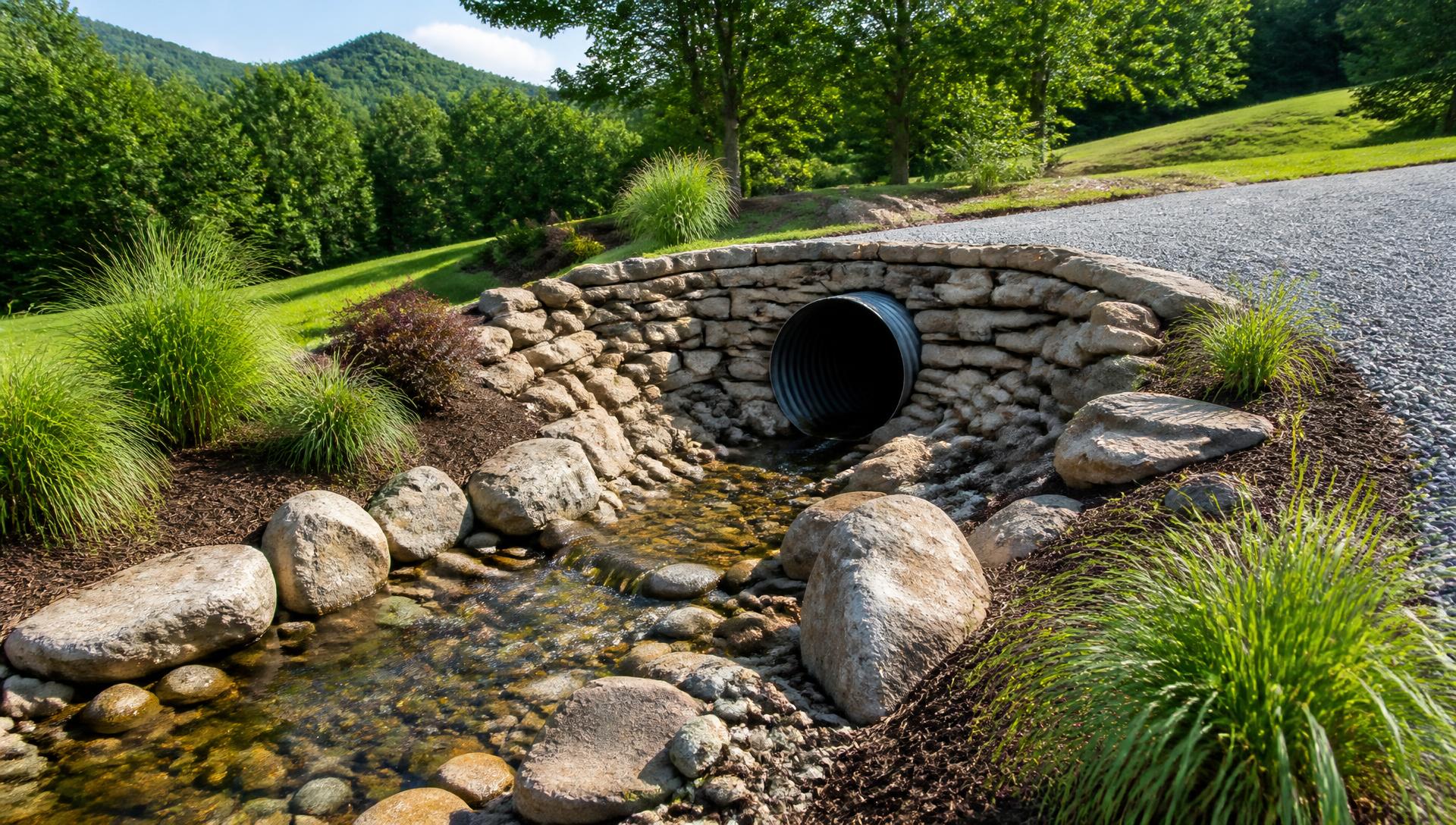
A daylight outlet with an animal guard, plus cleanouts so the system can be flushed instead of dug up.
Dry ground, a dry foundation, and a system you can flush instead of excavate.
How it goes
Our process
- Step 01
Diagnose
Confirm the water source before specifying any pipe.
- Step 02
Design fall
Establish the outfall elevation first, then work back uphill.
- Step 03
Install
Fabric, washed stone, perforated pipe, correct bedding.
- Step 04
Verify
Flow test the line and restore the surface.
Common questions
French Drains questions we get
- How deep should a French drain be?
- Deep enough to intercept the water causing the problem and to maintain fall to the outfall. A yard drain may only need eighteen inches; a footing drain has to sit at footing level. Depth is set by the outfall, not by a rule of thumb.
- How much slope does a French drain need?
- About one percent — roughly one inch of drop per eight to ten feet — is a reliable minimum. Less than that and silt settles out inside the pipe.
- Where does the water actually go?
- To daylight wherever grade allows, since gravity outfalls need no maintenance. Where there is no fall, a sump and pump or a properly sized dry well is the alternative.
- Do French drains fail?
- The ones without filter fabric, without fall or without an outlet do. Installed correctly with cleanouts, they run for decades with a periodic flush.
Where we work
Drainage & Erosion across North Georgia
We handle drainage & erosion for property owners across the north side of Atlanta — Cumming, Milton, Alpharetta, Roswell, Buckhead, Sandy Springs, Marietta, Woodstock, Canton and Ball Ground — and up through Jasper, Ellijay and Blue Ridge. Choose your area for local conditions, permitting and recent work nearby.
- Drainage & Erosion in CummingForsyth County
- Drainage & Erosion in AlpharettaFulton County
- Drainage & Erosion in RoswellFulton County
- Drainage & Erosion in Johns CreekFulton County
- Drainage & Erosion in BuckheadFulton County
- Drainage & Erosion in Sandy SpringsFulton County
- Drainage & Erosion in MariettaCobb County
- Drainage & Erosion in East CobbCobb County
- Drainage & Erosion in WoodstockCherokee County
- Drainage & Erosion in CantonCherokee County
- Drainage & Erosion in Ball GroundCherokee County
- Drainage & Erosion in JasperPickens County
- Drainage & Erosion in EllijayGilmer County
- Drainage & Erosion in Blue RidgeFannin County
- Drainage & Erosion in DawsonvilleDawson County
- Drainage & Erosion in CartersvilleBartow County
- Drainage & Erosion in BlairsvilleUnion County
- Drainage & Erosion in HelenWhite County
- Drainage & Erosion in ClevelandWhite County
- Drainage & Erosion in GainesvilleHall County
Regional overviews: Drainage & Erosion in North Georgia, Drainage & Erosion in Lake Lanier, Drainage & Erosion in North Georgia Mountains, Drainage & Erosion in North Atlanta.
Related work
Erosion Control
Slope stabilization, matting, riprap, silt control and revegetation that stops washouts on North Georgia clay and steep terrain.
ViewCulverts & Basins
Properly sized culverts, catch basins, cross-drains and outfalls that move storm volume off driveways, fields and building sites.
ViewFoundation Regrading
Positive-slope regrading, swales and drain tie-ins that move water away from foundations, crawl spaces and eroded driveways.
ViewStart here
Tell us about your property
Send the basics and we'll come back with a straight answer on what your site needs, what order to do it in, and what it's likely to cost.