Estate and Farm Site Preparation
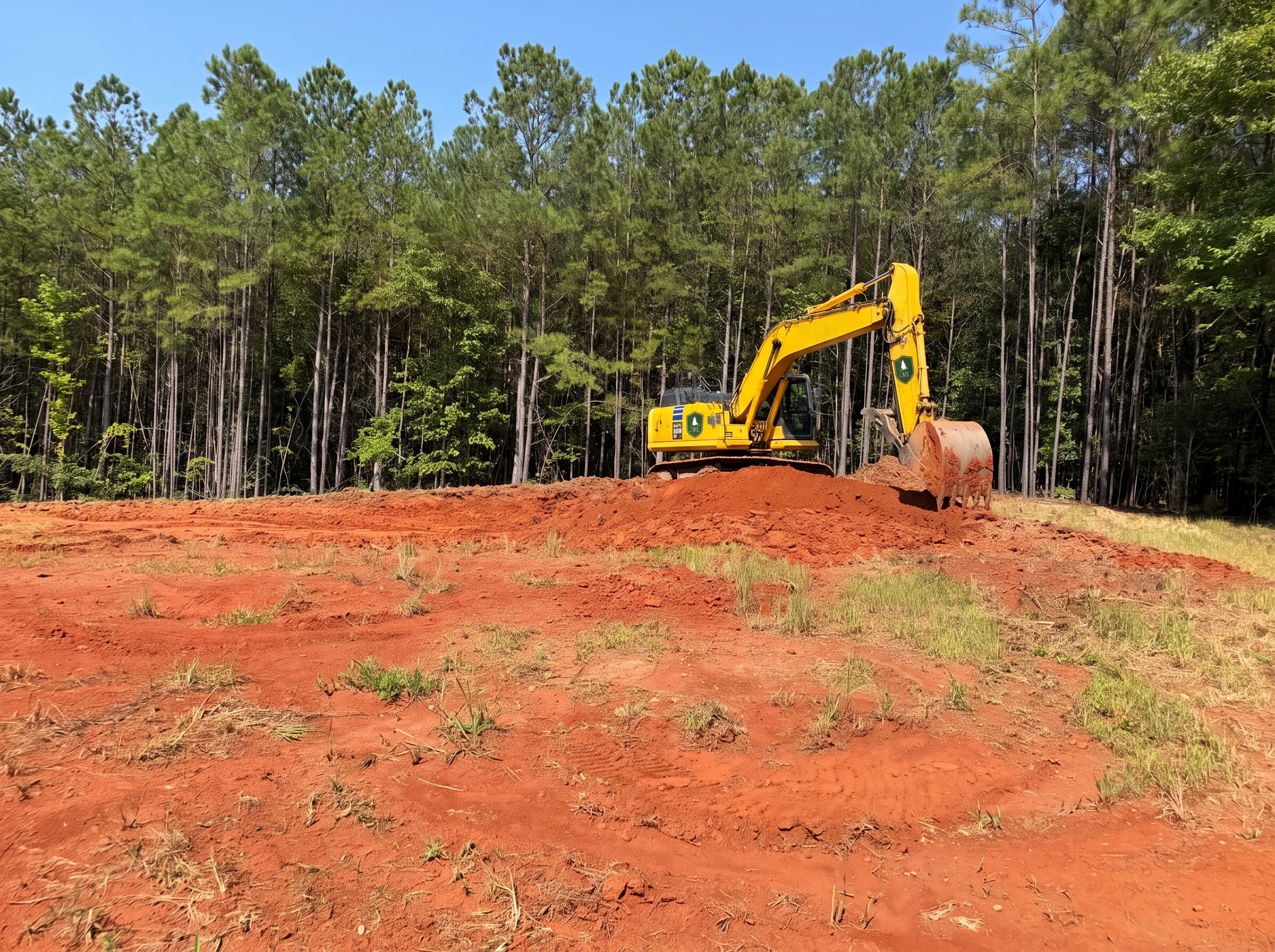
We grade and prepare sites across Hall County's range of terrain, from level pasture to steep near-lake lots, sequencing work to fit each property's specific soil and slope conditions.
Land Development
Hall County Estates
Gainesville anchors Hall County's mix of working poultry farms and Lake Lanier estate property, and we build for both sides of that market.
Start your property projectHall
Hall County's economy has run on poultry production for generations, and much of the acreage outside Gainesville's core is still working farmland: pasture, hay ground, and land supporting poultry operations. That land carries its own site needs, from farm road base to drainage that keeps runoff away from production facilities.
At the same time, Lake Lanier has made Gainesville's shoreline some of the most valuable residential land in North Georgia. Estate buyers here want privacy and lake access, which means grading and retaining wall work on the steep lots common around the lake's coves and points.
We treat Lake Lanier's Corps of Engineers shoreline rules as a separate, deeper topic covered on our dedicated Lake Lanier page. Here in Gainesville, our focus is the broader property: the driveway, the pad, the pasture, and the drainage that ties a working farm or a near-lake estate together.
What makes this market different
Hall County requires land disturbance permits and stream buffer compliance for grading beyond a set threshold, especially near tributaries feeding Lake Lanier. We prepare erosion control plans and manage the permit process.
Property near Lake Lanier's shoreline falls under Army Corps of Engineers regulations for grading, clearing, and structures within the lake's easement. We coordinate this separately for any project touching Corps-managed land, detailed further on our Lake Lanier page.
Many of the most desirable lake-adjacent lots sit on steep coves or points, requiring engineered retaining walls and careful grading to create usable outdoor space without excessive slope disturbance.
Working poultry and pasture operations need drainage that keeps runoff from farm areas from reaching nearby streams. We design containment and vegetative buffers that meet county and state agricultural runoff standards.
Featured services
We grade and prepare sites across Hall County's range of terrain, from level pasture to steep near-lake lots, sequencing work to fit each property's specific soil and slope conditions.
Land DevelopmentWhether it's runoff from a hay field or storm flow off a steep lakeside lot, we design drainage systems sized to Hall County's rainfall patterns and downstream buffer requirements.
Drainage & ErosionSteep lots near Lake Lanier's coves often need engineered walls just to create a usable pad or terrace. We build wall systems rated for the loads and drainage demands of lakeside terrain.
Retaining WallsWe build driveways ranging from working farm roads with a lighter base spec to paved estate approaches with proper drainage and retaining detail on steeper lake-adjacent lots.
Driveways & AccessFor Hall County's horse and hobby farm properties, we build fencing, run-in sheds, and pasture drainage suited to rolling farmland outside the lake corridor.
EquestrianWe install fencing suited to each property's use, from agricultural perimeter fencing on working land to more refined estate fencing near residential lake properties.
Fencing & EntriesWe build pads and foundations for barns and farm buildings sized to real agricultural use, with drainage planning that accounts for Hall County's clay soils.
Barns & OutbuildingsWe design and build patios and outdoor living spaces on estate lots near the lake, grading for both entertaining use and stability on sloped terrain.
Outdoor LivingWe coordinate the full property plan for estate buyers, tying together the homesite, access, and outdoor spaces while flagging where Lake Lanier's Corps rules will apply, with the fine detail handled on our Lake Lanier-specific planning.
Property PlanningProperty types
Cove and point properties near the shoreline requiring steep-slope grading and Corps of Engineers coordination.
Hall County agricultural land with farm road, drainage, and outbuilding needs tied to active production.
5 to 15 acre properties combining a residence with pasture, fencing, and light farm infrastructure.
Larger residential parcels close to but not directly on Lake Lanier, with easier grading than true shoreline lots.
Why owners choose us
We walk the land with you, read the topography and water, and separate what the site needs from what it would merely be nice to have.
Access, drainage, building envelopes and structures get planned together, with a phasing order that protects the budget.
Drawn plans for grading, walls, fencing, barns and landscape so every trade builds from the same document.
One crew and one point of contact, working the plan in the sequence that keeps finished work from being torn back out.
We walk the property after the first heavy rain, confirm everything drains and functions, and hand over a maintenance plan.
Featured work
Field notes
Two tracts can look identical from the road and cost $200,000 apart to develop. Here's what we look at on a first walk — before anyone signs anything.
ReadStructuresA leaning wall is almost never a block problem. It's water pressure behind a wall that had nowhere to drain — and it was decided the day the base was cut.
ReadPlanningYou don't have to build it all at once. You do have to build it in the right order — or year one gets torn out to make room for year four.
ReadQuestions
Answers specific to this market. If yours isn't here, call 678-578-8114.
We coordinate grading and construction work up to the Corps easement boundary and flag when a project needs Corps approval for shoreline work. Full shoreline permitting detail is covered on our dedicated Lake Lanier page, since those rules are distinct from standard county permitting.
Grading beyond the county's disturbance threshold, or any work near a stream buffer, requires a permit and erosion control plan. Most new driveway, homesite, or farm building projects on raw acreage will need one.
Yes, but runoff from farm areas needs to be managed with buffers or containment that keep sediment and waste out of the waterway. We design these systems to meet both agricultural and environmental compliance.
Steep lake lots generally require more retaining wall and engineered grading work than flat farmland, which drives cost up, but the actual number depends on grade, soil, and access. We provide a specific estimate after a site walk.
Yes. Runoff on steep lake-adjacent lots moves fast and can affect neighboring property or the shoreline itself if not managed. We design swales and drains specific to each lot's grade and Corps buffer requirements.
Farm roads use a lighter, less finished base suited to occasional equipment traffic, while estate driveways need deeper compacted base, sometimes paving, and more attention to grade and drainage for daily vehicle use.
A site walk during or after rain usually reveals runoff patterns from farm areas. We assess this as part of any drainage plan and design buffers or containment where needed to meet county and state standards.
Yes, this is common on hobby farms where owners want to keep livestock areas separate from lawn and outdoor living space. We design fence layouts that account for both use and drainage between zones.
Timelines depend on slope and Corps coordination where applicable, but a typical estate site prep, clearing, grading, and drainage, runs four to eight weeks before foundation work begins.
Confirm current agricultural use classification, check for any stream buffers crossing the property, and get a soil and drainage read before assuming the land is build-ready. We offer pre-purchase site evaluations for exactly this reason.
The base land disturbance permit process is the same, but lakefront work adds the Corps of Engineers layer and often stricter buffer enforcement given the proximity to Lake Lanier's water supply function. We plan for both from the start on shoreline-adjacent projects.
Nearby areas we serve
Start here
Tell us about your Gainesville property. We'll come back with what the site needs, what order to do it in, and what it's likely to cost.