A driveway that washes out is doing exactly what it was built to do: carry water. Every load of stone you add gives the water more to move. The fix is never more gravel — it's changing where the water goes, how fast it gets there, and what it runs across.
Cause one: the driveway is the drainage ditch
On sloped North Georgia lots the drive is often the lowest continuous line on the property, so runoff from the yard, the woods and the road collects on it and runs the full length. Water gathering speed over 300 feet has enough energy to carry #57 stone with it.
The fix is interception: break the run into short segments with broad water bars, rolling dips or cross drains so no single stretch ever accumulates enough flow to cut.
Cause two: no crown, no shoulder outlet
A driveway should shed water sideways within a few feet of where it lands. That requires a crown or a consistent cross-slope, plus a place for the water to actually go once it reaches the edge. A crowned drive with a berm of built-up gravel along both shoulders is a bathtub.
We regrade to a 2–4% cross-slope and cut the shoulder berms out so water leaves within feet, not hundreds of feet.
Cause three: stone over mud
Gravel placed directly on North Georgia clay pumps into the subgrade under traffic. Within two seasons the surface is soft, rutted and holding water — and the ruts channel the next storm.
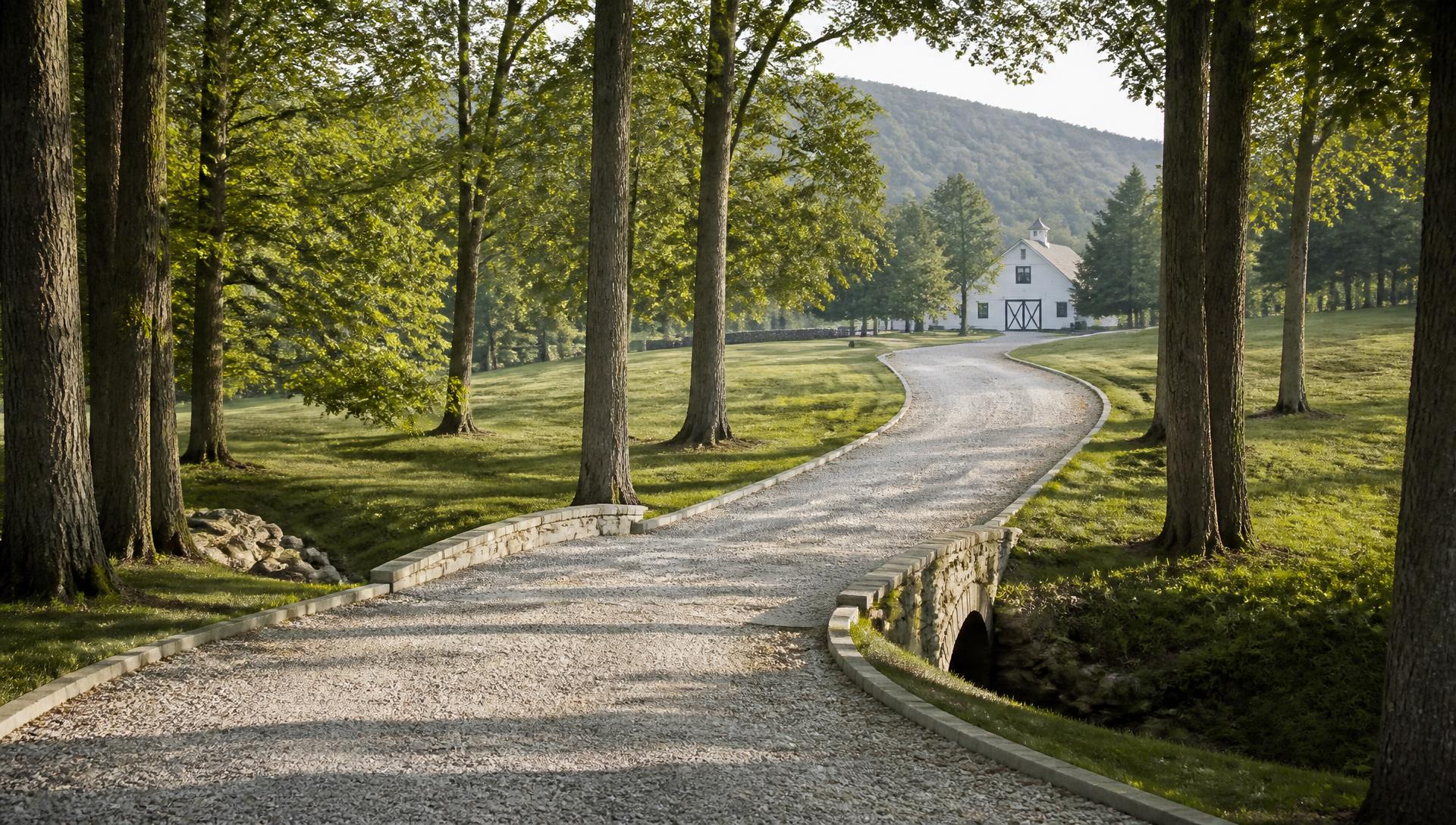
A driveway that lasts has structure: compacted subgrade, geotextile fabric where soils are wet, a graded aggregate base course, then a surface layer. That build costs more once and stops costing every year after.
- Geotextile separation fabric on soft or wet subgrade
- 6–8 inches of compacted graded aggregate base
- A surface course sized for traffic, not just appearance
- Culverts sized to the actual upstream drainage area
Cause four: undersized or blocked culverts
A 12-inch pipe under a crossing that drains 15 acres will overtop in any real storm, and when it does the water goes over the drive and takes it apart. Culverts also fail quietly by silting shut — inlets need headwalls and a maintainable approach.
What a permanent fix looks like
We start upstream of the driveway, not on it. Where is the water coming from, how much is there, and where can it be discharged safely — a stable outlet, a dry creek bed, a rip-rap apron, a level spreader into woods. Then we rebuild the drive with grade, base and cross-drainage that assume that water exists.
Done that way, the annual gravel bill goes away and the drive gets better with traffic instead of worse.
If you're re-graveling on a schedule, it's worth having someone read the water before you spend again. That's the first thing we look at on any access project.