
Cartersville, Georgia
Drainage & Erosion in Cartersville, Georgia
Cattle operations need reliable stock ponds. We evaluate watershed size and soil conditions to size ponds correctly and manage erosion around banks used for daily herd access.
Start your property projectDrainage & Erosion Control in North Georgia
Pond and Watershed Management
Cartersville and the surrounding Bartow County countryside sit in the broad Etowah River valley, where flatter, fertile bottomland has supported cattle operations and row crop agriculture for well over a century. The scale here is different from the smaller acreage tracts closer to metro Atlanta: fifty, one hundred, and even several-hundred-acre ranches are common, not the exception.
Adding another load of gravel to a washing driveway is a subscription, not a repair. Water is moving across your property along a route it chose. Our job is to give it a better one — sized correctly, armored where it needs to be, and invisible the rest of the year.
Full Drainage & Erosion serviceWhat we see locally
- Gravel drives that rut and wash after every heavy rain
- Standing water and soft ground near the house or barn
- Gullies cutting through pasture and hillsides
- Undersized or crushed culverts backing water up
Scope of work
How the work runs on a Cartersville property
Watershed assessment
We map where water enters your property, how much of it there is, and where it wants to go before specifying anything.
Surface conveyance
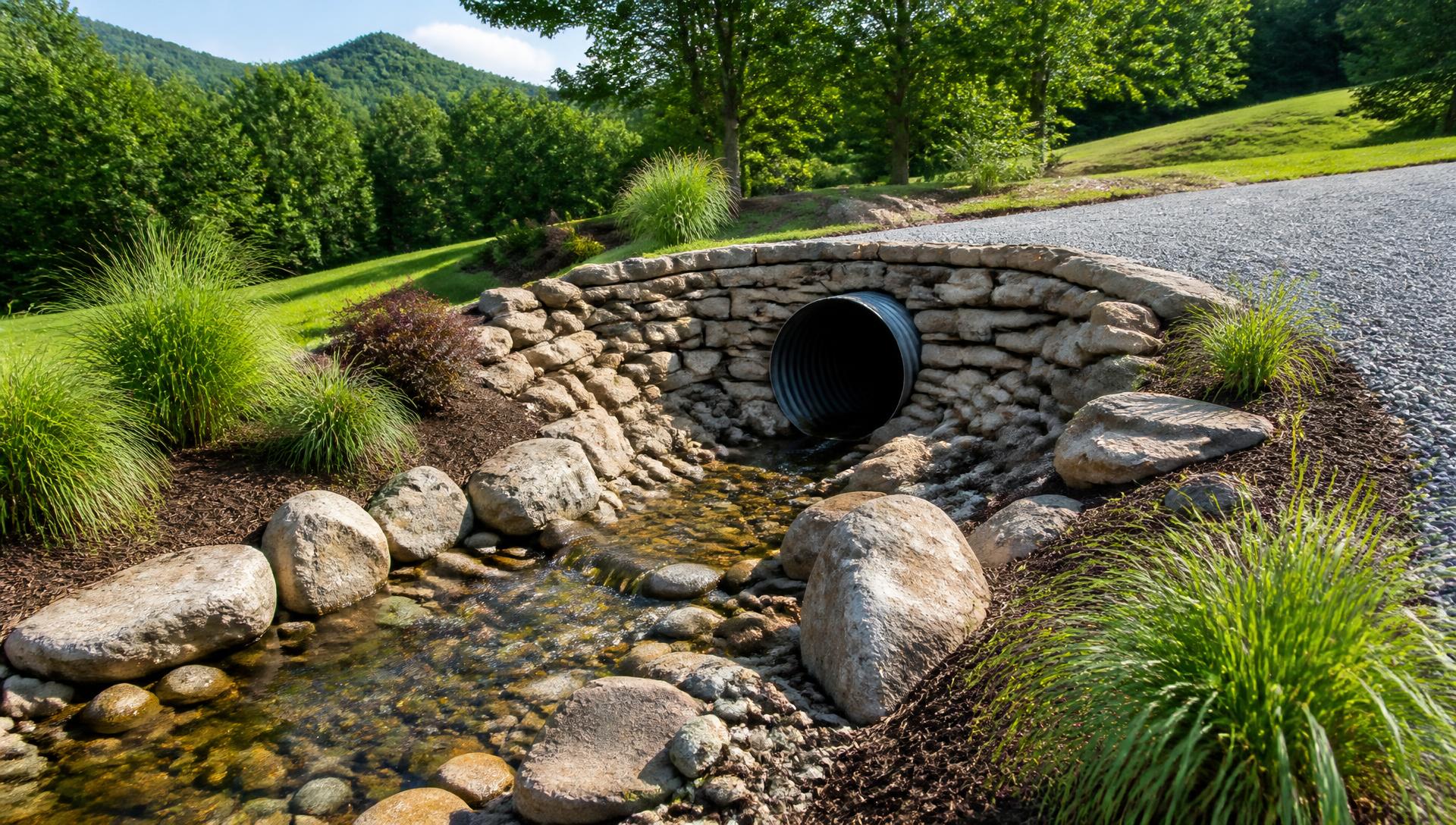
Crowning, swales, diversion berms, rock check dams and dry creek beds that carry volume without cutting into the ground.
Culverts & subsurface drainage
Properly sized pipe, headwalls, catch basins, French drains and footing drains installed at the grade they actually need.
Slope stabilization
Regrading, riprap, matting and deep-rooted seeding to hold banks and cut slopes through the first two rainy seasons and beyond.
A property that handles a five-inch rain without you walking outside to look. No annual gravel bill, no soft ground, no new gullies.
Local conditions
What Cartersville land does differently
EquestrianPlanning a Horse Property: Barns, Fencing, Access and Drainage TogetherLarge-scale fencing logistics
Fencing hundreds of acres for rotational cattle grazing requires material staging, terrain mapping, and phased installation that small-property fencing crews aren't equipped to handle. We plan these projects in sections tied to grazing rotation needs.
Agricultural tax exemption compliance
Many Bartow County ranch properties carry a conservation use or agricultural exemption that limits how much land can be developed or cleared without affecting tax status. We coordinate clearing plans with what the exemption allows.
Etowah River floodplain bottomland
The most fertile pasture and cropland often sits closest to the Etowah River and its floodplain, which restricts permanent structure placement even though the ground itself is prime grazing or crop land.
Farm road and heavy equipment access
Ranch operations need interior farm roads that hold up to tractors, hay equipment, and cattle trailers year-round, which requires a heavier base than a typical residential driveway.
Questions
Cartersville FAQs
What size ranch properties do you typically work on around Cartersville?
We regularly work on properties from fifty to several hundred acres, though the scope and sequencing of work adjusts significantly based on total acreage and current land use.
How does the conservation use tax exemption affect land clearing?
Georgia's conservation use assessment requires the land to stay in a qualifying use, so clearing beyond what's necessary for agricultural operations can jeopardize that tax status. We plan clearing scope around what the exemption allows before starting work.
Can I build near the Etowah River on my property?
It depends on the FEMA floodplain boundary for your specific parcel. Bottomland close to the river is often excellent pasture or crop ground but restricted for permanent structures, so we plan homesites and barns on higher ground when possible.
How long does it take to fence a large rotational grazing system?
A multi-paddock system across a hundred-plus acres typically takes several weeks to a few months depending on terrain, number of paddocks, and material lead times, and we often phase installation around active grazing needs.
What's involved in building a farm pond for cattle?
We evaluate the watershed feeding the pond site, soil suitability for holding water, and how the herd will access it daily, then size and grade the pond and dam accordingly, often with state approval required for larger structures.
Can you convert a cattle operation into a horse property?
Yes, this is common as ownership changes. It typically involves upgrading fencing to horse-safe materials, adjusting pasture rotation for equine grazing needs, and reworking barn interiors for stalls rather than open cattle housing.
Keep exploring
Start here
Start your property project
Send us the property details and we'll tell you what drainage & erosion work your site in Cartersville actually needs.